Cargo and Logistics Industry in India: A Complete Guide to Modern Transport, PTL, FTL, Warehousing and Supply Chain Services
Every product sitting on a shelf, every parcel delivered to a doorstep, every machine installed on a factory floor got there because a logistics network moved it. That’s the industry we’re talking about — not glamorous, often invisible, but entirely load-bearing when it comes to how the economy actually functions.
India’s logistics sector has changed dramatically over the last ten years. The combination of highway expansion, GST simplification, e-commerce growth, and serious government investment in freight infrastructure has pushed the industry into a new phase. What used to be dominated by informal operators and paper-based bookings is now increasingly GPS-tracked, digitally managed, and professionally structured.
This guide covers the full picture — how the industry works, what the different service types actually mean, where technology fits in, what’s still broken, and why the eastern India market in particular is at an inflection point.
What the Cargo and Logistics Industry Actually Covers
At its core, logistics is about moving goods from where they’re produced to where they’re needed — reliably, on time, and without damage. But the modern industry extends well beyond putting boxes on trucks. Today’s logistics ecosystem includes:
- Road freight — PTL and FTL transportation
- Warehousing and inventory storage
- Express courier and last-mile delivery
- Freight forwarding and customs clearance
- Cold chain and temperature-controlled transport
- Packers and movers for household and commercial relocation
- Reverse logistics for e-commerce returns
- Supply chain consulting and management
The sectors that depend on these services span nearly the entire economy — manufacturing, FMCG, pharmaceuticals, electronics, automotive, construction, agriculture, retail, and e-commerce all require functional logistics networks to operate.
The objective hasn’t changed: get the right product to the right place, in the right condition, at the lowest viable cost. What has changed is how complex and technology-dependent achieving that has become.
Why Logistics Matters More Than Most Businesses Realise
India’s geographic scale creates a logistics challenge that most countries simply don’t face. Serving 28 states, over 700 districts, and 1.4 billion people from a network of production centres and distribution hubs requires infrastructure, organisation, and coordination at a level that directly determines whether a business can compete in new markets or not.
Poor logistics doesn’t just cause delivery delays — it raises costs, damages customer relationships, and limits where a business can realistically sell. Conversely, companies that get their logistics right can serve more markets faster, hold less inventory, and respond more efficiently when demand shifts.
Government programmes including PM Gati Shakti, the Bharatmala highway programme, Dedicated Freight Corridors, and the National Logistics Policy have all been designed to close the gap between India’s logistics costs and global benchmarks. Progress is visible — transit times on key corridors have dropped, freight costs have fallen since GST eliminated inter-state checkpost delays, and port connectivity has improved.
Eastern India — Bihar and Jharkhand specifically — has seen meaningful infrastructure investment through these programmes, with new highway stretches and industrial corridor development changing what’s logistically possible for businesses based in the region.
Types of Logistics Services
1. PTL (Part Truck Load) Transport
PTL is what most small and medium businesses actually use, even if they don’t call it that. When a business doesn’t have enough cargo to fill an entire truck, PTL lets it share truck space with other shippers — paying only for what it uses.
In Bihar and Jharkhand, PTL freight services typically operate through a hub-and-spoke consolidation model. Goods from multiple customers are combined at central hubs in cities like Patna, Ranchi, and Jamshedpur, then dispatched on fixed schedules across the region’s districts.
This model works well for FMCG distributors, electrical goods suppliers, retailers managing regular inventory replenishment, e-commerce returns, and small industrial consignments. The trade-off is that PTL involves more handling points than FTL — which makes packaging quality more important.
2. FTL (Full Truck Load) Transport
FTL gives a single customer exclusive use of an entire vehicle. The truck moves directly from pickup to destination without stops, consolidation, or mid-journey offloading. For large or high-value consignments, this matters — less handling means lower damage risk and faster transit.
Industries in Bihar and Jharkhand moving steel, machinery, construction materials, or bulk consumer durables rely heavily on FTL transport for shipments where speed, security, and direct delivery are non-negotiable. GPS tracking on dedicated FTL vehicles provides full visibility from the moment the truck leaves until it arrives.
FTL is the right choice when cargo volume justifies the cost of a full vehicle, when goods are fragile or high-value, or when delivery deadlines are tight.
3. Warehousing and Storage
Holding inventory closer to your customers is one of the most effective ways to improve delivery speed and reduce last-mile costs. A warehouse in Jamshedpur serving Jharkhand districts means same-day or next-day delivery to those markets — something impossible if every order ships from a distant national distribution centre.
Modern warehousing facilities go well beyond four walls and a loading dock. Barcode and RFID scanning, 24/7 CCTV monitoring, climate-controlled zones for temperature-sensitive goods, dedicated loading docks, and automated inventory management systems are now standard expectations for professional warehousing operations.
For businesses scaling distribution across Bihar and Jharkhand, strategic warehousing at key hubs is often the difference between competitive delivery performance and falling behind.
4. Courier and Express Delivery
Express logistics has grown faster than almost any other segment, driven almost entirely by e-commerce. The expansion of online shopping into tier-2 and tier-3 cities across Bihar and Jharkhand has created demand for reliable last-mile delivery networks reaching every district — including areas that informal operators have historically served poorly.
Real-time tracking, OTP-based delivery verification, and next-day service across major corridors are now baseline expectations. Platforms like Amazon, Flipkart, Meesho, and Myntra have conditioned consumers to expect speed and visibility that only professionally organised networks can deliver consistently.
5. Packers and Movers
Industrial expansion, corporate transfers, and urban migration across Bihar and Jharkhand have driven strong demand for professional household and office relocation services in cities like Jamshedpur, Ranchi, Patna, and Dhanbad.
Professional packers and movers services cover household shifting, commercial relocation, vehicle transport, and professional packing and unpacking — with insurance options to protect against damage. The quality of packing materials and handling procedures directly determines whether goods arrive intact.
How Technology Is Changing Logistics Operations
Ten years ago, most Indian logistics companies ran on phone calls, paper manifests, and experience. That’s changing fast, and the gap between technology-enabled operators and traditional ones is widening every year.
GPS Fleet Tracking
Real-time GPS tracking is now a standard expectation, not a premium feature. Customers want to know where their cargo is. Businesses want proof of route adherence and delivery times. Fleet operators need visibility to manage driver performance and prevent theft. The VAHAN portal and regulatory requirements around vehicle tracking have also pushed adoption across commercial fleets.
Fleet Management Software
Beyond location tracking, fleet management platforms help logistics companies reduce fuel costs through route optimisation, manage driver compliance, schedule preventive maintenance, and monitor vehicle condition across hundreds of trucks simultaneously. For operations spanning Bihar and Jharkhand’s varied terrain and long inter-district routes, digital fleet management isn’t optional — it’s what keeps delivery schedules intact.
Warehouse Automation
RFID systems, barcode scanning at every inventory movement point, AI-powered stock management, and automated sorting are making warehouse operations faster and more accurate. The payoff is fewer incorrect shipments, better stock visibility, and faster order processing — particularly important for e-commerce fulfilment where speed and accuracy are both critical.
AI and Predictive Analytics
Larger logistics networks are using AI to move from reactive to predictive operations — analysing historical data to anticipate demand surges, pre-position fleet resources, optimise last-mile routing, and reduce empty vehicle runs. This is still emerging in eastern India but will become increasingly relevant as organised logistics operators scale up across Bihar and Jharkhand.
Challenges the Industry Still Hasn’t Fully Solved
The growth story is real, but so are the friction points. Any honest assessment of Indian logistics has to include these:
Fuel costs remain the largest single operational expense in road freight. Diesel price volatility makes freight pricing unpredictable and squeezes margins on fixed-rate contracts.
Driver shortage is a structural problem. India has a growing deficit of licensed, long-distance truck drivers, and the demographic pipeline isn’t filling the gap fast enough. This pushes wages up and limits fleet expansion for growing operators.
Road congestion in major cities and on key freight corridors causes delays that no amount of GPS tracking can fix — only route planning and off-peak scheduling can partially compensate.
Last-mile infrastructure in rural Bihar and Jharkhand districts remains uneven. National highway connectivity has improved significantly, but district and block-level road quality still creates challenges for reliable last-mile delivery in remote areas.
Cargo damage from improper handling and poor packaging continues to generate losses, disputes, and customer complaints — particularly for electronics, white goods, and fragile industrial equipment.
The Logistics Landscape in Bihar and Jharkhand
Bihar and Jharkhand together cover 62 districts and a combined population exceeding 150 million people. That’s a large, underserved market that organised logistics companies are only beginning to penetrate at scale.
The two states have distinct freight profiles. Jharkhand’s economy is anchored in steel, mining, and heavy manufacturing — generating strong demand for bulk FTL freight, industrial cargo movement, and inter-state transport to markets in West Bengal, Odisha, and beyond. Bihar’s rapidly expanding consumer economy drives demand for FMCG distribution, retail replenishment, e-commerce logistics, and PTL freight across all 38 districts.
The key freight hubs define how goods move through the region:
- Jamshedpur — steel and industrial corridor hub, highest freight volumes in Jharkhand
- Ranchi — Jharkhand capital and primary state distribution centre
- Patna — Bihar’s commercial logistics hub, connecting all 38 districts
- Dhanbad — coal belt gateway, connecting Jharkhand with Bihar and West Bengal
- Bokaro — steel city freight centre
- Muzaffarpur — North Bihar agricultural and FMCG distribution hub
- Bhagalpur — East Bihar corridor
- Gaya — South Bihar distribution point
The shift from informal transport operators to organised, GPS-tracked logistics companies is accelerating across both states, driven by businesses that need documentation, accountability, and supply chain visibility that informal operators simply can’t provide.
Why Cargo Handling Standards Matter
Damaged goods aren’t just a financial loss — they trigger supply chain disruptions, customer complaints, insurance disputes, and reputational damage that compounds over time. For logistics providers, damage rates are one of the clearest indicators of operational quality.
Professional handling means soft-loading and securing methods that absorb transit vibration, trained staff who understand how to handle electronics and fragile goods differently from bulk materials, and high-quality protective packaging applied consistently — not just when the customer is watching.
This matters most for electronics, consumer appliances, white goods, high-value industrial equipment, and precision instruments — categories where a single damaged consignment can cost more than weeks of freight revenue.
Where the Industry Is Heading
The structural direction of Indian logistics is clear, even if the timeline is uncertain:
Electric trucks are moving from pilot projects to early commercial deployment on urban and short-haul routes. Several manufacturers are already operating electric commercial vehicles, and the economics will shift further as charging infrastructure expands.
Smart warehouses with automated picking, predictive replenishment, and real-time inventory visibility will become the baseline for serious fulfilment operations — particularly as e-commerce volumes in tier-2 markets continue rising.
Digital freight platforms are improving load matching, reducing empty runs, and giving smaller businesses access to freight capacity that previously required established broker relationships.
Green logistics — sustainable transport, eco-friendly packaging, carbon-neutral supply chains — is moving from a CSR talking point to a procurement requirement for large corporations, which will cascade down to their logistics partners.
Drone delivery in remote and hard-to-reach areas, particularly for medical supplies and lightweight parcels in rural districts, remains a medium-term prospect rather than an immediate reality — but regulatory frameworks are developing.
What to Look for in a Logistics Partner
Choosing a logistics provider isn’t just a cost decision. The right partner directly influences delivery performance, damage rates, customer satisfaction, and how far a business can realistically expand its market reach.
The practical checklist: GPS tracking on every vehicle, documented handling procedures, clear insurance arrangements, a hub network that actually covers the districts you need, fixed departure schedules you can plan around, and a track record of accountability when things go wrong — not just promises before the contract is signed.
For businesses in Bihar and Jharkhand, the additional consideration is regional depth. A provider with genuine last-mile coverage across all 62 districts — not just the major cities — is meaningfully different from one that handles Patna and Ranchi well but passes everything else to informal sub-contractors.
SafeShift Logistics: Cargo and Freight Services Across Bihar and Jharkhand
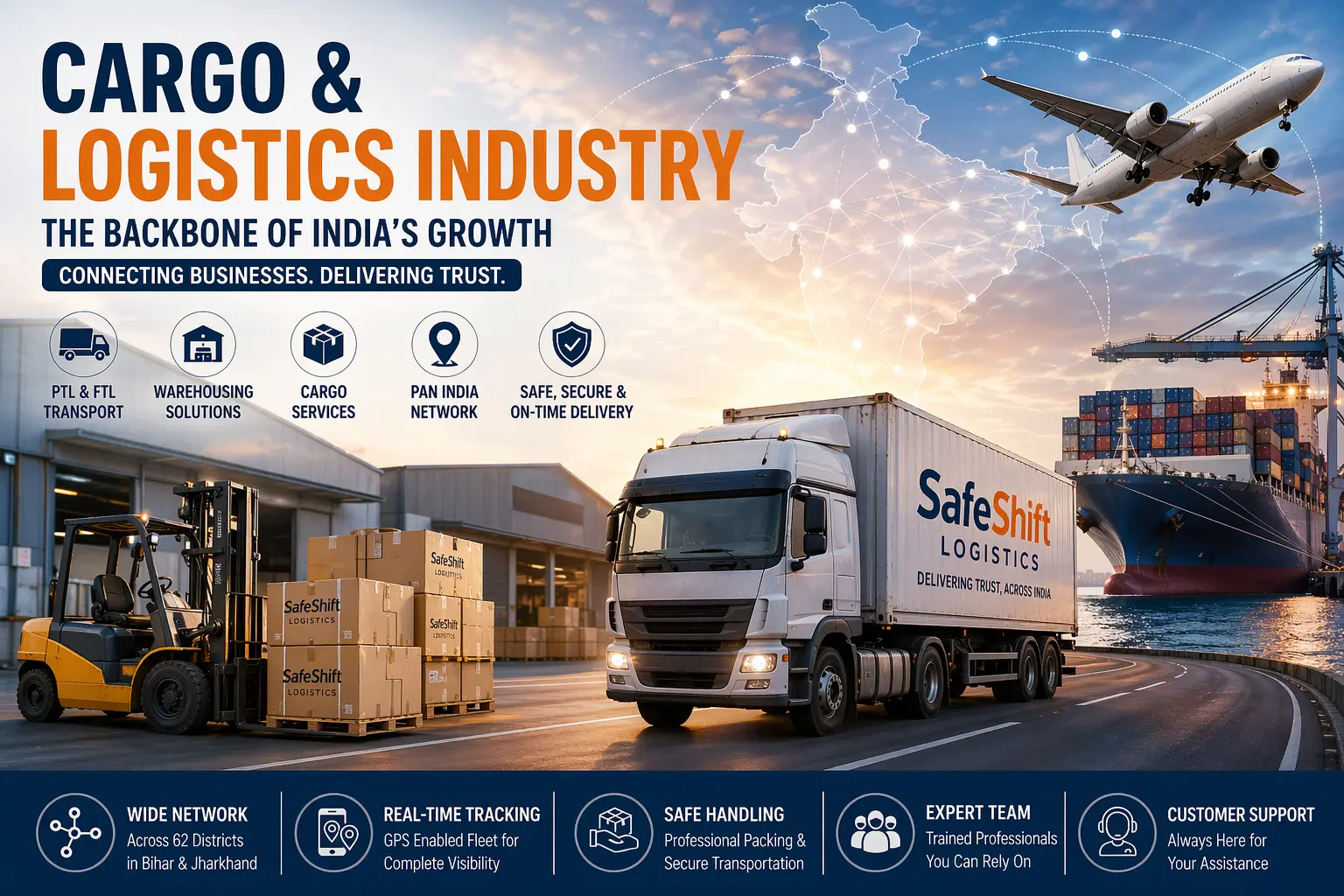
SafeShift Logistics Pvt. Ltd. has operated across Bihar and Jharkhand since 2013, with its headquarters in Jamshedpur and branch offices in Ranchi, Patna, and Dhanbad. The network covers all 62 districts across both states, handling PTL freight, FTL transport, warehousing, express delivery, packers and movers, and specialist cargo for industries including steel, FMCG, electronics, and consumer durables.
The company’s cargo transportation services operate on fixed daily departures from all four hubs, with GPS-tracked vehicles, trained loading teams, and a proprietary MIS system providing shipment visibility throughout transit. For businesses that have outgrown informal freight arrangements and need a documented, accountable logistics partner across eastern India, get in touch with the SafeShift team for a quote.
Conclusion
India’s logistics industry is in the middle of a structural upgrade — moving from fragmented, informal, paper-based operations toward organised, technology-enabled, professionally managed networks. That transition is creating real opportunities for businesses that get their supply chains right and real competitive disadvantages for those that don’t.
For businesses operating in Bihar and Jharkhand, the regional opportunity is significant. Both states are growing faster than the national average in consumer spending and industrial output, and the logistics infrastructure to serve that growth is finally beginning to match the demand. The companies that build reliable logistics partnerships now — rather than after distribution problems have already cost them market share — will be better positioned for what comes next.